

For production use, enforce an algorithm allowlist, validate the signature plus exp, iss, and aud on every request, and issue short-lived access tokens paired with rotated refresh tokens. Everything else in JWT security is a variation on those three moves.
If you implement nothing else this sprint, do these:
- Must: Pin an explicit algorithm allowlist in your verification call and reject
noneand case variants likenoNE. - Must: Validate signature,
exp,nbf,iss, andaudon every single request, not just at login. - Must: Serve traffic over HTTPS only, and never store tokens in
localStorage. - Do: Set access token TTLs between 5 and 15 minutes, backed by rotating refresh tokens.
- Do: Hash refresh tokens before storing them server-side so a database leak doesn't hand out live sessions.
- Consider: Publish a JWKS endpoint with a 5 to 15 minute cache window if you're using asymmetric keys across services.
Key Takeaways
Securing a JWT implementation requires algorithm allowlisting, full claim validation on every request, and short-lived access tokens paired with rotated, hashed refresh tokens.
| Point | Details |
|---|---|
| Pin your algorithms | Reject none and confirm the algorithm explicitly in every verify call, never trusting the token's own header. |
| Validate every claim | Check signature, exp, nbf, iss, and aud on every request, not only at login. |
| Keep tokens short-lived | Use 5 to 15 minute access tokens with 7 to 30 day rotated refresh tokens stored hashed. |
| Never store secrets in the payload | Base64url is not encryption; keep JWTs to minimal identifiers and use JWE for sensitive fields. |
| Debug with the right tools | Pingfloat's free JWT Decoder and JSON Formatter help verify claims and catch misconfigurations before deployment. |
Table of Contents
- JWT Best Practices Start With Understanding the Token's Structure
- How Should You Validate a JWT on Every Request?
- Which Algorithms and Key Management Practices Actually Hold Up?
- What Are the Right JWT Expiration Best Practices?
- Where Should You Store and Transport JWTs?
- What Belongs Inside a JWT Payload?
- How Do You Revoke a JWT and Handle Logout Correctly?
- What Are the Most Common JWT Security Vulnerabilities?
- What Does a Practical JWT Implementation Checklist Look Like?
- What Tradeoffs Should You Actually Weigh in Production?
- Debug and Verify Your JWT Implementation Before It Ships
- Sources
JWT Best Practices Start With Understanding the Token's Structure
A JSON Web Token is three base64url-encoded segments separated by periods: header, payload, and signature. The header names the algorithm and key; the payload carries claims; the signature proves the first two haven't been tampered with. That's a JWS, a signed token. A JWE wraps the payload in encryption instead, so the contents are hidden from anyone without the decryption key, not just protected from tampering. Most APIs use JWS. JWE shows up when the payload itself contains something you don't want a client or intermediary to read.
The registered claims do most of the heavy lifting in a well-built token:
| Claim | Purpose |
|---|---|
iss | Identifies the party that issued the token |
sub | Identifies the subject, typically a user ID |
aud | Names the intended recipient service |
exp | Expiration timestamp, after which the token is dead |
iat | Issued-at timestamp, useful for auditing and skew checks |
jti | Unique token ID, needed for revocation and reuse detection |
Skip any of these and you inherit a validation gap somewhere downstream.
How Should You Validate a JWT on Every Request?
Validation order matters more than most teams realize. Checking claims before you've confirmed the signature means you're trusting attacker-controlled data. Run these steps, in order, every time a token hits your server:
- Verify the signature first, using a key resolved from your own trusted store or JWKS endpoint, never from a key hint the token itself supplies without cross-checking.
- Confirm the algorithm matches your allowlist. If your service expects ES256, reject anything else outright, including
none. - Check
expandnbfagainst the current server time, allowing a small clock skew window (30 to 60 seconds is typical). - Validate
issandaudagainst the exact strings your service expects, not a substring or prefix match. - Look up
jtiagainst a denylist or check a token-version counter if your system supports revocation.
RFC 8725 is explicit that a signature alone doesn't make a token trustworthy. The IETF's current draft guidance tells implementers to never trust the alg header blindly and to run an explicit allowlist rather than accepting whatever the token claims to use. That single rule closes off most of the classic JWT forgery attacks before they start.
When configuring library calls, pass the expected algorithms, issuer, and audience explicitly rather than relying on defaults. Most JWT libraries accept a verification options object where you list algorithms as an array, set issuer and audience strings, and define a clockTolerance in seconds. Leaving these blank is how "we validated the signature" quietly becomes "we validated nothing about who the token was for."
Pro Tip: Sanitize the kid header value before using it to look up a key. Treat it as untrusted input, strip anything that isn't alphanumeric, and never pass it directly into a file path or SQL query. Attackers have used malformed kid values to trigger path traversal and injection against key stores.
Which Algorithms and Key Management Practices Actually Hold Up?
Asymmetric algorithms in the RS and ES families are the safer default for anything beyond a single monolith. ES256 is a solid choice where your libraries support it, offering smaller signatures than RS256 with comparable security margins. The reason to lean asymmetric: only your signing service holds the private key, while every consumer service verifies with a public key. Nobody downstream can forge a token, even if they can read it.

HS256 and other symmetric algorithms sign and verify with the same secret. That's fine for a single service talking to itself. In a microservices setup, it means every service that needs to verify tokens also needs the secret that can create them, and a secret shared across a dozen services is a secret that will eventually leak. RFC 8725 flags this exact tradeoff and pushes toward algorithm choices with sufficient key entropy and minimal blast radius, as detailed in the official RFC 8725 specification.
Key rotation shouldn't require downtime. The pattern that works:
- Add the new key to your JWKS document alongside the old one.
- Start signing new tokens with the new key, referenced by its
kid. - Keep accepting tokens signed by the old key for at least as long as your access token TTL.
- Remove the old key from the JWKS once you're confident nothing valid still references it.
Consumers should cache the JWKS response for 5 to 15 minutes, which balances key rotation speed against hammering your JWKS endpoint on every request.
What Are the Right JWT Expiration Best Practices?
Short access tokens and longer, rotated refresh tokens are the pattern that keeps showing up across implementation guides for good reason: it limits how long a stolen access token stays useful without forcing users to log in every five minutes.
- Access tokens: 5 to 15 minutes is the range most production systems land on.
- Refresh tokens: 7 to 30 days, depending on how sensitive the application is and how often users return.
- High-risk domains like banking or healthcare should sit at the tight end of both ranges, or tighter still.
Refresh token rotation is the piece teams skip and later regret. Every time a refresh token gets used, issue a brand new one and invalidate the old one immediately. Store refresh tokens hashed server-side, the same way you'd store a password, so a database compromise doesn't hand out working sessions. Group related refresh tokens under a family ID; if an old, already-rotated token gets used again, that's a strong signal of theft, and you can revoke the entire family on the spot.
freeCodeCamp's implementation guide walks through exactly this pattern: short-lived access tokens plus rotated, hashed refresh tokens stored in HttpOnly cookies. It's become close to a default for a reason.
Revocation hygiene comes down to three tools, used situationally:
- Short TTLs handle most cases passively; a stolen token simply expires fast.
- Denylists (often backed by Redis) work for immediate, targeted revocation but add a lookup on every request.
- Token version counters on the user record let you invalidate every token for that user in one write, useful for "log out everywhere" flows.
Where Should You Store and Transport JWTs?
Storage choice determines your exposure to XSS and CSRF, and there's no option that eliminates both risks entirely.
| Storage location | XSS risk | CSRF risk | Typical use case |
|---|---|---|---|
| HttpOnly cookie | Low, script can't read it | Present, needs SameSite/CSRF token | Web apps with server-rendered or same-origin frontends |
| In-memory (JS variable) | Moderate, vulnerable if XSS runs during session | None | SPAs pairing access tokens with a cookie-based refresh flow |
localStorage | High, any injected script can read it | None | Not recommended for tokens carrying real privileges |
For cookies, set HttpOnly so client-side scripts can't touch the value, Secure so it only travels over TLS, and SameSite=Strict (or Lax if your flow needs cross-site redirects) to blunt CSRF. Scope the Path narrowly to your refresh endpoint rather than the whole domain.
For API traffic, Authorization: Bearer headers remain the standard for access tokens, while refresh tokens work best bound to a single, dedicated refresh endpoint rather than sent alongside every API call. Always run this over TLS. An unencrypted JWT in transit is just a signed confession waiting to be intercepted.
What Belongs Inside a JWT Payload?
Keep the payload to identifiers and required claims: sub, iss, aud, exp, iat, and jti cover most needs. Anything beyond that should earn its place.
What never belongs in a JWT payload: passwords, API keys, raw personally identifiable information, or financial data. Base64url encoding looks obscured, but it isn't encryption. Anyone with the token can decode the payload in seconds using a basic browser console, so treat it as visible, not hidden.
- Include the minimum set of claims your downstream services actually need to make decisions.
- Never assume a JWT is a safe place to cache business data just because it's convenient.
- If a payload genuinely must carry sensitive fields, encrypt it with JWE instead of relying on JWS alone.
- For very sensitive sessions, an opaque, server-side session token can be the better call than a JWT at all.
Pro Tip: If you're debugging why a claim looks wrong in production, don't guess. Decode the actual token and inspect the raw payload rather than trusting what your code assumes it sent.
JWE adds real overhead: encryption and decryption on every verification, plus key management for both signing and encryption keys. For most APIs, minimizing claims and adding TLS in transit gets you most of the security benefit without that cost. Reach for JWE, or for opaque server-side sessions, when the payload truly can't be minimized down to safe identifiers.
How Do You Revoke a JWT and Handle Logout Correctly?
JWTs are stateless by design, which is exactly what makes revocation awkward. Three approaches cover almost every real scenario:
- Short access token TTLs do the passive work: a compromised token has a small window before it's dead anyway.
- Denylists, typically in Redis keyed by
jti, let you kill a specific token immediately when you know it's compromised. - Token version counters on the user record let you invalidate every token tied to that user in a single update, ideal for "log out of all devices."
Logout should do three things in sequence: revoke the refresh token's database record, clear the refresh cookie client-side, and optionally add the current access token's jti to a short-lived denylist so it can't be replayed for its remaining lifetime.
- Log every refresh token use, including the token family ID and requesting IP.
- Alert on reused, already-rotated refresh tokens immediately; that pattern almost always means theft.
- Track failed validation attempts by reason (
expired,bad signature,wrong audience) rather than lumping them into one generic error count, since the breakdown tells you whether you're looking at expired sessions or an active attack.
What Are the Most Common JWT Security Vulnerabilities?
The alg:none attack tricks a poorly configured verifier into accepting an unsigned token as valid, because the header says there's no algorithm to check. Algorithm confusion goes a step further: an attacker takes a service's public RS256 key and uses it as an HMAC secret to forge an HS256-signed token that a careless verifier accepts. Both die instantly once you pin an explicit algorithm allowlist rather than trusting whatever the token header claims.
Signing a token is not the same as securing it. A JWT's safety depends entirely on the validation logic surrounding it, not on the fact that it happens to carry a signature.
Other pitfalls worth naming directly:
kidinjection during key lookup, fixed by sanitizing the value before it touches a file path or query.- Long-lived tokens with no rotation, which just extend the damage window for any leak.
- Refresh tokens in
localStorage, exposed to any successful XSS injection. - Weak HMAC secrets, often short strings or dictionary words that brute-force tools can crack in hours.
What Does a Practical JWT Implementation Checklist Look Like?
Run through this before you ship an authentication flow:
- Pin an explicit algorithm allowlist in every verify call, on every service.
- Validate
exp,nbf,iss, andaudon every request, not just at issuance. - Set access tokens to 5 to 15 minutes and refresh tokens to a bounded window that fits your risk profile.
- Rotate refresh tokens on every use and hash them before storage.
- Publish a JWKS endpoint if you're on asymmetric keys, with a sane cache window.
- Log validation failures by reason and alert on refresh token reuse.
Three minimal patterns, language-agnostic in spirit:
- Node (jsonwebtoken):
jwt.verify(token, publicKey, { algorithms: ['ES256'], issuer: 'api.example.com', audience: 'app' }) - Setting a refresh cookie:
res.cookie('refresh_token', token, { httpOnly: true, secure: true, sameSite: 'strict', path: '/auth/refresh' }) - Python rotation (pseudocode):
store.replace(old_refresh_hash, new_refresh_hash, family_id=family)
Java teams following OWASP's JWT cheat sheet get equivalent guidance on secure library configuration and explicit validation, which maps almost one-to-one onto the Node and Python patterns above.
Test coverage should include unit tests for every validation branch (expired, wrong audience, bad signature, malformed algorithm), integration tests that exercise the full refresh rotation cycle, and a specific test for reuse detection: replay an already-rotated refresh token and confirm the whole family gets revoked. Wire a monitoring hook into that reuse path in production, since it's your earliest signal of token theft.
What Tradeoffs Should You Actually Weigh in Production?
Short access token TTLs are the right default for most applications, but "most" is doing real work in that sentence. A banking or healthcare API handling account transfers or medical records deserves tighter TTLs and more aggressive revocation checks than a content app where a stale session just means someone sees yesterday's data.
Fully stateless JWTs are elegant, but elegance isn't always the right tradeoff. If your product needs instant, guaranteed revocation for compliance reasons, an opaque token backed by a server-side session store, checked on every request, is often the more honest choice than a JWT with a denylist bolted on to fake the same behavior. Stateless JWTs scale better; opaque sessions revoke better. Pick based on which failure mode actually worries you.
The thing that saves teams in production isn't a clever algorithm choice. It's monitoring that catches a reused refresh token within minutes instead of during a post-incident review three weeks later.
Debug and Verify Your JWT Implementation Before It Ships
Every rule in this guide comes down to one habit: actually looking at what's inside your tokens before you trust them. Pingfloat's JWT Decoder lets you paste a token and instantly see the decoded header, payload, and expiration, so you can confirm your claims and TTLs match what you intended before a bug reaches production.
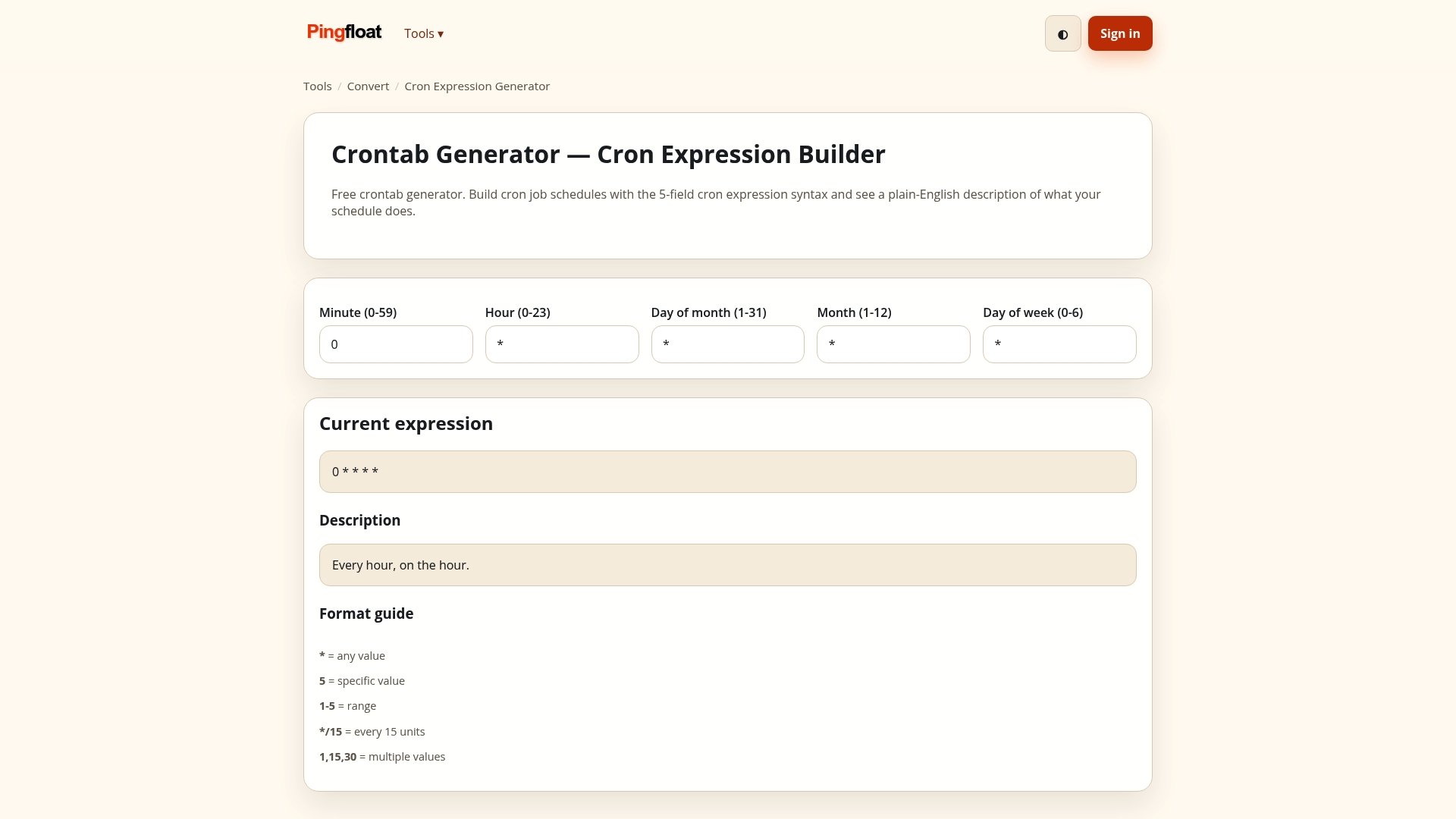
Pair it with the JSON Formatter to clean up messy claim payloads or error responses while you're debugging validation logic, and the Response Headers Inspector to confirm your cookie flags (HttpOnly, Secure, SameSite) are actually landing the way your code says they should. If you're also managing the infrastructure behind your auth service, Pingfloat's Website Uptime Monitor keeps watch on your JWKS endpoint and auth servers so a rotation window doesn't quietly turn into an outage. All of these tools are free. Open the JWT Decoder now and check the last token your service issued.
Sources
- draft-ietf-oauth-rfc8725bis-09 — IETF
- RFC 8725 - JSON Web Token Best Current Practices
- How to build a secure authentication system with JWT and refresh tokens — freeCodeCamp
- JWT Best Practices: Security, Expiry, and Storage | Jsonic
Link these directly in your code comments and security documentation so the reasoning behind each check stays traceable for the next engineer who touches the auth flow.