

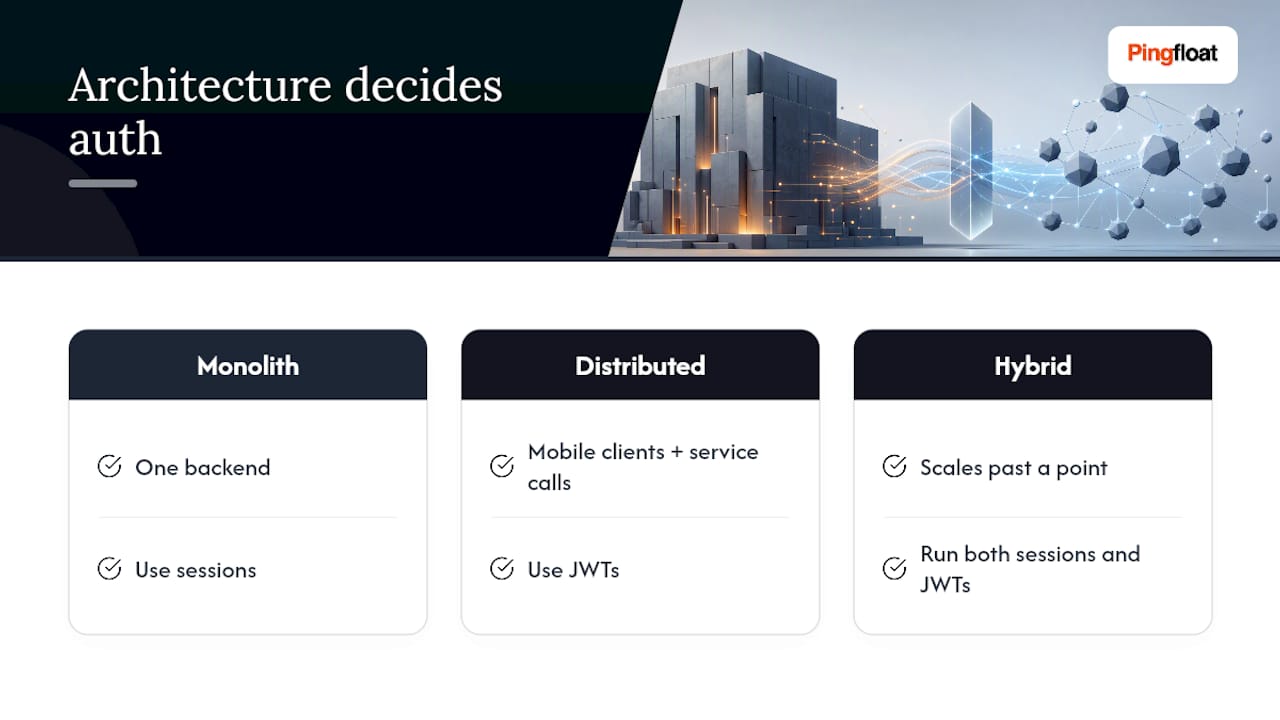
If your app is a single first-party web backend, use server-side sessions. If it's a distributed API or mobile client talking to multiple services, use short-lived JWTs with refresh rotation. Sessions win on instant revocation; JWTs win on stateless, cross-service verification. Most production systems that need both end up running a hybrid, and OWASP's session guidance plus RFC 7519 cover the hardening either path requires.
TL;DR:
- Short-lived JWTs with refresh rotation are better suited for distributed systems or mobile apps, while sessions excel in single-backend web applications.
- Instant revocation favors sessions, but JWT revocation requires solutions like denylists or token versioning, which add complexity.
- JWTs increase overhead in requests due to larger size and can be mishandled with localStorage, raising XSS risks, whereas sessions are more vulnerable to CSRF but easier to revoke instantly.
- Implementing secure cookies with proper flags and server-side store backing is crucial for sessions, while JWT security depends on short expiration, key rotation, and algorithm pinning.
- Most production systems benefit from a hybrid approach, using server-side sessions for UI and short-lived JWTs for internal service communication, rather than one solution alone.
Table of Contents
- JWT vs Sessions: Comparing Revocation, Scale, and Attack Surface
- Security Trade-Offs: CSRF, XSS, Token Theft, and Revocation
- Implementation Patterns and Anti-Patterns Worth Knowing
- A Decision Checklist for Choosing Sessions, JWTs, or Both
- Tools for Debugging Your Auth Setup
- The Bottom Line on JWT vs Sessions
- Why the JWT-Everywhere Trend Gets This Backwards
- Sources
JWT vs Sessions: Comparing Revocation, Scale, and Attack Surface
Before comparing the two, separate three things people mix up constantly: how the credential travels (cookie vs header), what format it takes (opaque ID vs signed claims), and where the truth lives (server memory/database vs the token itself). A session is a database row with an ID sitting in a cookie. A JWT is a self-contained, signed claim set the server never has to store.
That distinction drives every trade-off below.
- Revocation: Sessions revoke instantly, delete the row, and the user is out. JWTs stay valid until they expire, since the server has no record to erase. Killing one early requires a blocklist or a
tokenVersionfield, which reintroduces the exact server state JWTs were supposed to avoid. - Scalability / cross-service verification: JWT authentication was built for stateless, distributed setups where every microservice verifies a token locally with a public key instead of calling a shared auth server. Sessions need a shared store, typically Redis, reachable from every instance. Session lookups are usually sub-millisecond in practice, so the real cost isn't latency, it's operational: one more dependency that has to stay up and stay replicated across regions.
- Storage and transport: Sessions ride in a small, opaque cookie, typically a few dozen bytes. JWTs carry their claims inline and commonly run 200 to 800+ bytes depending on how many claims you pack in, adding overhead to every request header.
- XSS vs CSRF exposure: Cookie-based sessions are CSRF-prone (state-changing endpoints need tokens or origin checks) but resist casual XSS token theft when marked HttpOnly. JWTs stored for header-based auth dodge CSRF entirely but are frequently mishandled into
localStorage, where any XSS bug hands over the whole token. - Implementation complexity: Sessions are simple until you scale horizontally. JWTs are simple to verify but deceptively hard to revoke, rotate, and secure correctly.
- Best for: Sessions fit single-backend web apps, admin panels, and anything requiring an audit trail of active logins. JWTs fit mobile apps, third-party APIs, and service-to-service calls across a microservices mesh.
Security Trade-Offs: CSRF, XSS, Token Theft, and Revocation
Cookies and Authorization headers fail differently, and that difference should dictate your defense, not just your architecture. A session cookie sent automatically by the browser on every request is exactly what makes CSRF possible: an attacker's page triggers a request, the cookie tags along, and your server can't tell it wasn't the user clicking a button. SameSite and HttpOnly flags, plus CSRF tokens or strict origin checks on state-changing routes, close that gap. JWTs sent via an Authorization: Bearer header aren't attached automatically, so CSRF mostly disappears, but now a successful XSS attack can just read the token straight out of JavaScript-accessible storage and impersonate the user indefinitely, or until it expires.
Revocation is where JWTs get uncomfortable. Three patterns handle it, each with a cost:
- Short TTL plus refresh rotation. Keep access tokens alive for 5 to 15 minutes, issue a rotating refresh token behind them, and every stolen access token expires fast on its own. This is the approach most current JWT guidance converges on.
- Denylist. Store revoked token IDs somewhere fast to check. It works, but you've now rebuilt a session store just to patch over the thing JWTs were supposed to eliminate.
tokenVersionfield. Bump a version number tied to the user record; any token signed against an old version fails verification. Cheap, but it invalidates every session for that user at once, not just one device.
A handful of hardening moves apply regardless of which pattern you pick: pin the signing algorithm explicitly (never trust the alg header from the token itself), rotate signing keys on a schedule, keep claims minimal since JWT payloads are base64url-decodable and readable by anyone, enforce HTTPS and a real Content Security Policy, and regenerate the session ID after any privilege change like a password reset or role upgrade.
Pro Tip: Store refresh tokens in an HttpOnly, Secure cookie, not in JavaScript-reachable storage, and rotate the refresh token every time it's used. If a stolen refresh token gets used twice, that's your signal an attacker has a copy, and you can kill the whole chain immediately.
Implementation Patterns and Anti-Patterns Worth Knowing
Sessions done right lean on a few unglamorous details: use the __Host- cookie prefix, set Secure, HttpOnly, and an appropriate SameSite value, back the store with Redis or a managed key-value service, and generate session IDs with real entropy, not sequential integers. TTLs should match the sensitivity of the app; a banking session shouldn't idle for a week.
JWTs done right favor RS256 over HS256 whenever multiple services need to verify tokens, since RS256 lets you distribute a public key without handing out the signing secret. Pin the algorithm on the verifying side so nobody can downgrade a token to none. Keep access tokens short-lived, five to fifteen minutes is standard, and always check exp, iat, aud, and iss on every verification, not just the signature.
The pragmatic middle ground: run server-side sessions for browser UX, then mint a short-lived, narrowly scoped JWT whenever that session needs to call an internal service. The session handles login state and instant logout; the JWT handles cross-service trust for a few minutes at a time. This is common enough in production that it's less a compromise than a standard pattern in distributed systems.
Watch for these anti-patterns:
- Storing JWTs in
localStorage, which hands them to any successful XSS payload. - Issuing long-lived JWTs with no rotation, turning a stolen token into a standing backdoor.
- Treating expiry as your only revocation strategy when the app actually needs a hard logout.
- Bolting JWTs onto a monolith that already has a perfectly good session store, adding complexity for no real gain.
A partner overview on session UX and hardening walks through some of the smaller polish details, like how session expiry messaging affects retention, that pure security writeups tend to skip.
A Decision Checklist for Choosing Sessions, JWTs, or Both
Work through these in order and you'll land on an answer fast, not a maybe.
- Is this a first-party, browser-only app with one backend? If yes, use sessions. Follow-ups: set cookie flags correctly, stand up a Redis-backed store, and test logout actually clears the session.
- Do multiple services need to verify identity independently? If yes, JWTs earn their keep. Follow-ups: pick RS256, define a minimal claim set, and set up key rotation.
- Do you need instant, guaranteed revocation (compromised account, compliance mandate)? If yes, sessions or a JWT denylist. Follow-ups: build the kill switch first, test it under load, and log every revocation event.
- Are mobile apps or third-party API consumers involved? If yes, JWTs, since cookies don't travel well outside a browser. Follow-ups: implement refresh rotation, cap access token life at 15 minutes, and version your token schema.
- Does compliance require an auditable trail of session starts and terminations? If yes, keep a session layer even if you also issue JWTs downstream.
| Scenario | Pick | 3-step rollout |
|---|---|---|
| Single-backend web app | Sessions | Harden cookies, monitor store health, test forced logout |
| Microservices / distributed API | JWTs | Pin algorithm, rotate keys, automate refresh rotation |
| Mobile + web + internal services | Hybrid | Session for UX, short-lived JWT per service call, test both revocation paths |
Tools for Debugging Your Auth Setup
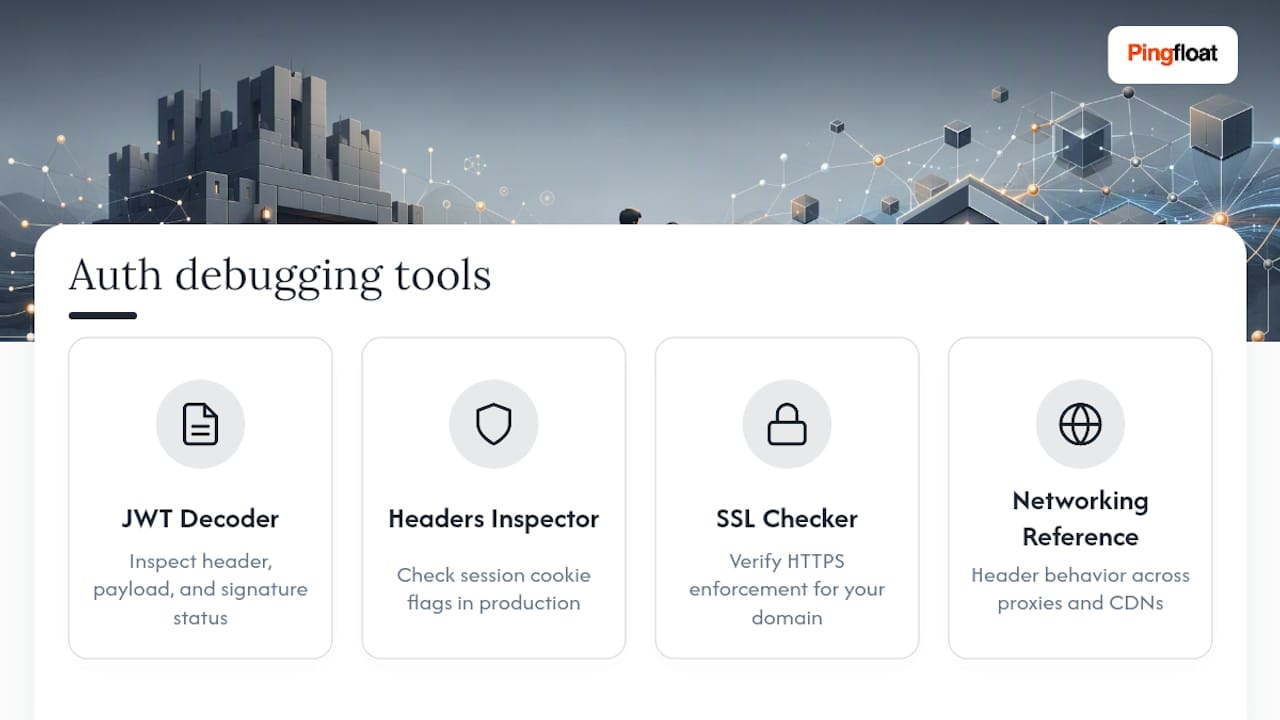
Getting the theory right doesn't help much if you can't verify what's actually shipping in a request. Pingfloat's JWT Decoder lets you paste a token and inspect its header, payload, and signature status directly, which is the fastest way to confirm your exp, iat, and aud claims are actually set the way your code intends. Pair that with the Response Headers Inspector to check whether your session cookies actually carry Secure, HttpOnly, and SameSite flags in production, not just in your local environment. If your auth flow depends on HTTPS enforcement, run the SSL Checker against your domain before you assume it's configured correctly. For token transport issues across proxies or CDNs, Pingfloat's networking reference covers the header behavior that trips up a lot of JWT-over-HTTP setups.
The Bottom Line on JWT vs Sessions
Architecture decides this, not preference. A monolith with one backend almost always wants sessions; a distributed system with mobile clients and internal service calls almost always wants JWTs, and most real systems that scale past a certain point end up running both at once. Three things to do this week: apply cookie and token hardening across every environment, not just production; add monitoring plus an automated revocation test so you actually know your kill switch works before you need it; and stage refresh rotation and key rotation changes in a test environment before touching prod. Check your live setup with the Website Uptime Monitor or start from Pingfloat's full tool suite to catch configuration drift before an attacker does.
Why the JWT-Everywhere Trend Gets This Backwards
The industry spent the better part of a decade treating JWTs as the modern replacement for sessions, and that framing was wrong from the start. JWTs solve a specific problem, verifying identity across services without a shared store, and they're a poor fit for anything that doesn't have that problem. A single Rails or Django monolith gains nothing from switching to JWTs and loses instant revocation in the process. That's not a stylistic preference; it's a straight downgrade in security posture for zero architectural benefit.
What gets underrated is how much of the "JWT vs sessions" debate is actually a revocation debate wearing a different costume. Every serious JWT implementation eventually reinvents some form of server-side state, a denylist, a token version, a refresh store, because pure statelessness and real-world account security don't coexist cleanly. Once you accept that, the hybrid pattern stops looking like a compromise and starts looking like the honest answer most systems were always going to need.
— Andreas